

Folklore and Wool: Reflections on “The Sheep Ate Up the Fairies”

For the past five months, several of my masks have been part of the exhibition The Sheep Ate Up the Fairies at Trowbridge Museum — a wonderfully imaginative exploration of how industrialisation reshaped Wiltshire’s wool towns and, with them, the older rhythms of rural life. As the exhibition draws to a close today, I’ve been reflecting on the seven pieces I contributed — each exploring how Wiltshire’s woollen heritage and folklore continue to weave through my creative practice today.
The exhibition’s theme was both clever and poignant. It examined how, in Wiltshire’s “woollen” towns, industrialisation transformed not only how people worked, but also the rhythm of their rural lives. As mills rose and handcrafts declined, the older stories — the fairies, green men, and spirits of field and forest — seemed to fade. But of course, they never truly disappeared.
My work, made entirely from wool, felt at home in this context — a modern reimagining of those very traditions that once seemed lost to progress. The seven masks displayed together told their own story of transformation, connection, and return.
Lydia Shears – The Hare That Runs Unseen

Folklore does not vanish — it lingers in the land, in whispers on the wind, in the spaces where the old ways still breathe.
Lydia Shears of Winterslow, accused of witchcraft, was said to transform into a hare to escape her hunters. Fearing her magic, they fashioned a silver bullet from a melted-down sixpence, believing it the only way to stop her. Some say she was later found dead, the bullet lodged in her heart. But others are not so sure…
Look closely: the silver glint in her eye, the shimmer of her whiskers — perhaps Lydia was never caught at all.
This mask embodies the idea that folklore has never disappeared, only slipped into the shadows. As industry reshaped Wiltshire, old customs were buried — but like Lydia, they remain, watching and waiting, ready to re-emerge.
Ryeland Ram – The Wool That Changed Worlds

The Ryeland Ram stands at the crossroads of tradition and industry. Once prized for its fine fleece, Ryeland wool helped fuel the Industrial Revolution, feeding the mills that transformed Trowbridge into a thriving wool town.
For a felter, wool is more than just fibre — it is a living material, full of history and potential. This mask honours the Ryeland sheep, whose fleece shaped Wiltshire’s past, while celebrating the timeless artistry of wool craft.
Though industry once overshadowed tradition, the magic of wool endures. It remains a thread that connects past and present — a material that still holds the power to create, to transform, and to tell stories anew.
Scrumpy Jack – The Green Man Reimagined

The Green Man, an ancient symbol of nature’s power and renewal, appears in carvings, folklore, and seasonal traditions across Britain. This mask, Scrumpy Jack, is a modern tribute to that enduring spirit — rooted in the orchards and wassailing customs of Wiltshire.
First created for the Trowbridge Apple Fair, this design reflects the deep connection between people and the land. Wassailing — singing to bless the apple trees — ensured good harvests, and though such traditions waned for a time, they are joyfully returning.
Like the orchards that blossom anew each spring, folklore, too, can return. The twin of this mask, Whispers of Wassail, has since found a home in Canada — proof that the Green Man’s spirit travels far beyond Wiltshire’s fields.
Folklore is not lost — only waiting to grow again.
Herne the Hunter – The Wild Spirit of the Forest
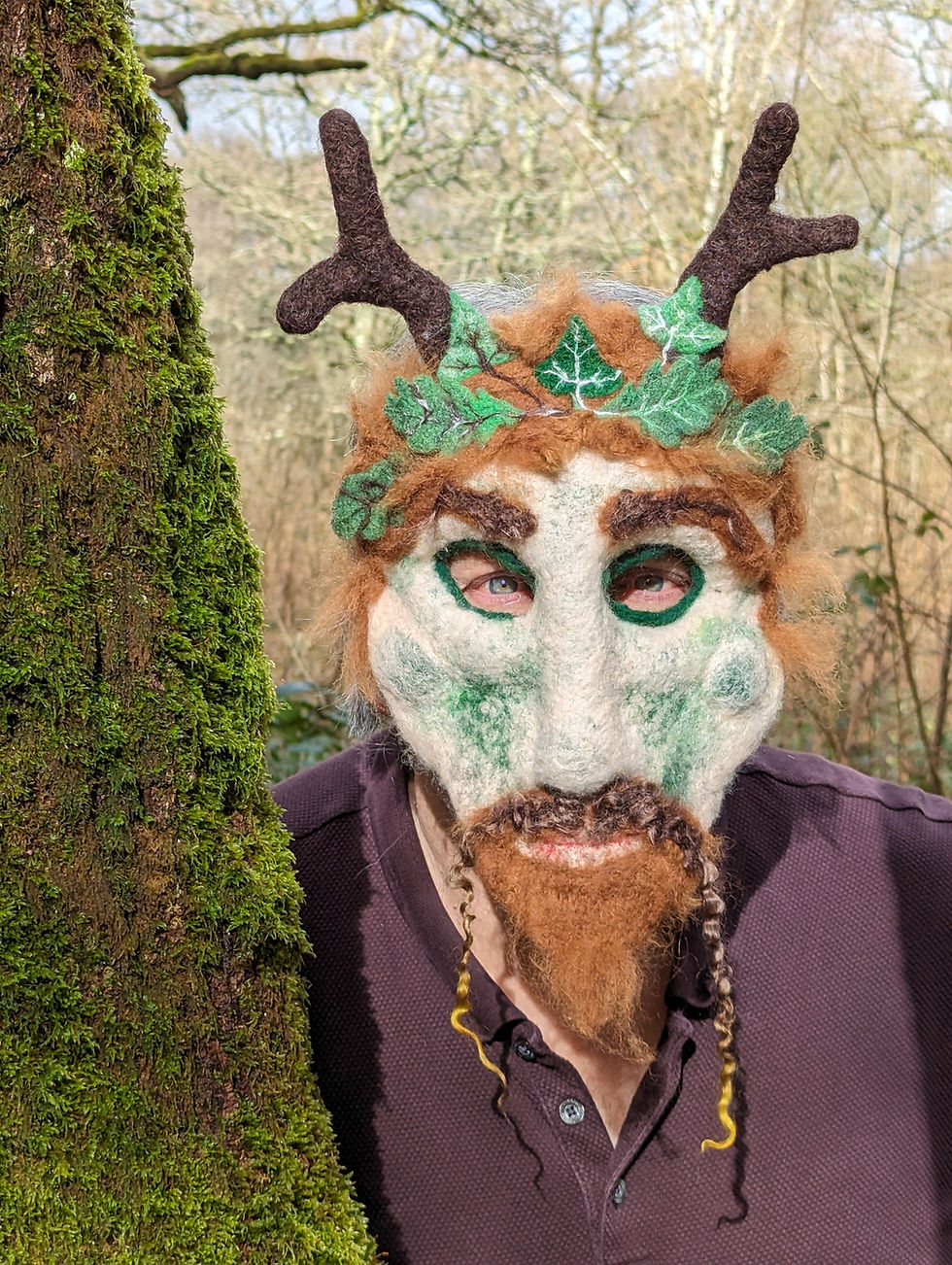
Herne is a figure of ancient mystery—antlered, shadowed, and half-wild. He is said to haunt Windsor Forest, a spirit of nature’s untamed power and of those who live close to it. My Herne the Hunter mask was created to capture both his strength and his solitude—a reminder that the Green Man has many faces, and not all of them gentle.
In the context of The Sheep Ate Up the Fairies, Herne felt like a powerful symbol of what industrialisation suppressed: the raw, pagan vitality of the countryside. His watchful presence in the museum—among the relics of looms and wool presses—felt almost defiant, as though the forest itself had returned to reclaim a corner of the mill.
Red Stag – Protector of the Woodlands

The stag has long been a creature of myth—sacred to Cernunnos, protector of the forest, and symbol of endurance and renewal. My Red Stag mask draws on this ancient imagery, its glowing russet tones representing vitality and transformation.
Displayed beside Herne, the two seemed to speak to one another: one the hunter, one the hunted—each a mirror of the other, reminding us that folklore is full of such dualities.
Purple Sprite – A Spirit of Imagination

The Purple Sprite emerged quite unexpectedly during my creative process—a playful being, lighter in tone and energy than the others. With its whimsical colours and impish expression, it represented for me the mischievous side of folklore—the fairies and sprites who delight in turning the ordinary strange.
In a show about industry and imagination, this piece reminded visitors that creativity itself is a kind of magic, and that joy and mischief are just as vital to tradition as solemnity and ceremony.
Unicorn – A Dream Fulfilled

Finally, the Unicorn, perhaps the most enduring of mythical creatures, stood as a symbol of purity, hope, and transformation. In wool, it becomes something tangible—soft but strong, otherworldly yet handmade. It reminds us that imagination can be real, if we only dare to shape it with our hands.
A Living Tradition
Being part of The Sheep Ate Up the Fairies exhibition has felt like closing a circle — returning the wool of Wiltshire to the heart of its history, not as industry but as art.
For me, felting is more than a technique. It’s a conversation between past and present — between the fleece of the sheep that once fed the mills and the hands that now shape it into masks of myth and memory.
As the exhibition ends, I’m left with a deep sense of gratitude — for the opportunity to contribute, for the stories that endure, and for the creative dialogue that continues to grow between our ancient traditions and the modern world.
Though the fairies may have been “eaten up” by the sheep, it seems they’ve found their way back again — perhaps hiding, in the magic of wool.


header.all-comments